
Is Your Workplace Fatigue Risk Management Reactive Rather Than Preventative?
Fatigue Kills
Root Cause of Major Environmental Accidents
Lost Productive Work Time (LPT)
Fatigue-Related Organisational Costs
Reactive Workplace Fatigue Management
Workers “Feel Fine” and Continue Working
Potential Financial Costs of Workplace Fatigue
BaselineNC Solution: The ONLY Real-Time Workplace Fatigue Monitoring Wearable With 98% Biometric Data Accuracy
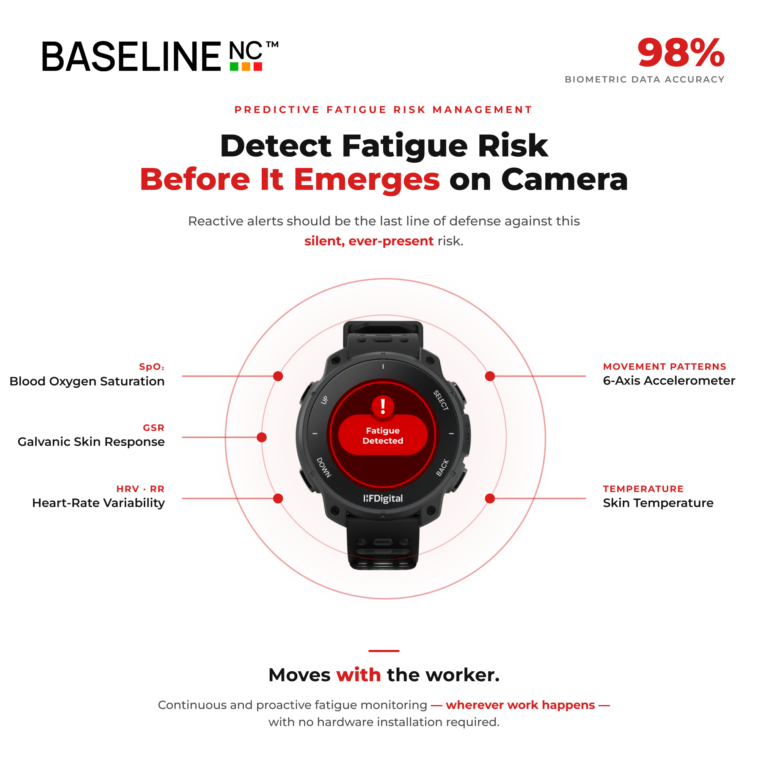
Mitigate Your Fatigue-Related Accidents and Incidents
Increase Your Workers Safety and Productivity
Reduce Your Fatigue-Related Organisational Costs
Enable Predictive and Preventative Workplace Fatigue Management
Support Healthy Working Patterns
Empower Enterprise-Wide Workplace Fatigue Management
BaselineNC Mobile Application: Available on Android™ and iOS®
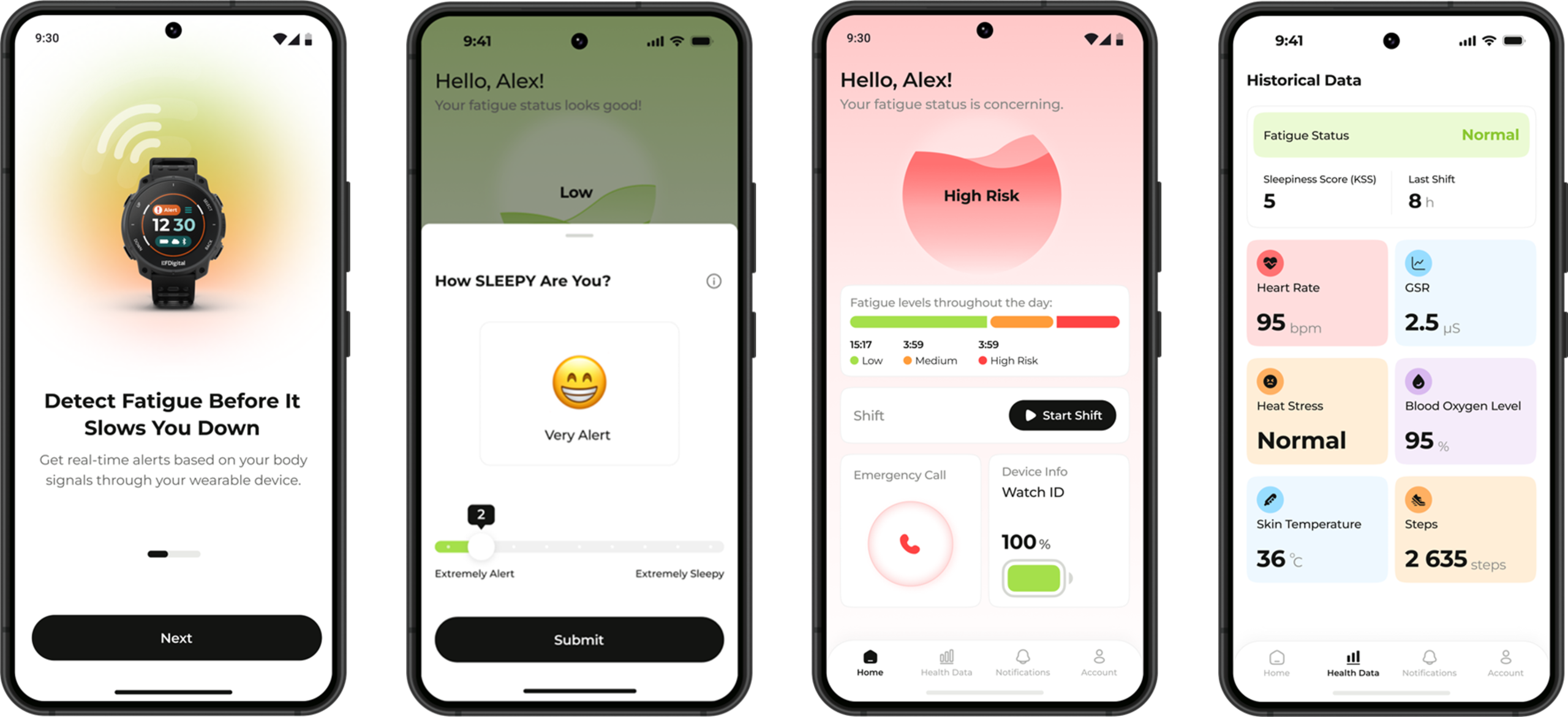
Detect Fatigue Risk Before It Emerges on Camera
Workplace fatigue monitoring is evolving fast, but not all solutions are created equal. While eye tracking measures blink rates and gaze patterns, wearable sensors go deeper. BaselineNC uses personalised biometric data such as blood oxygen saturation, galvanic skin response, heart rate variability (RR), movement patterns using a 6-axis accelerometer and skin temperature for a more holistic view of fatigue:
Wearable Technology
- Real-Time Alerts
- Cost Effective
- Detects the Onset of Fatigue
- Ease of Use
- High Accuracy Level
- Mobile
- Straightforward Implementation
- Unobtrusive
Eye Tracking Technology
- Real-Time Alerts
- Cost Effective
- Detects the Onset of Fatigue
- Ease of Use
- High Accuracy Level
- Mobile
- Straightforward Implementation
- Unobtrusive
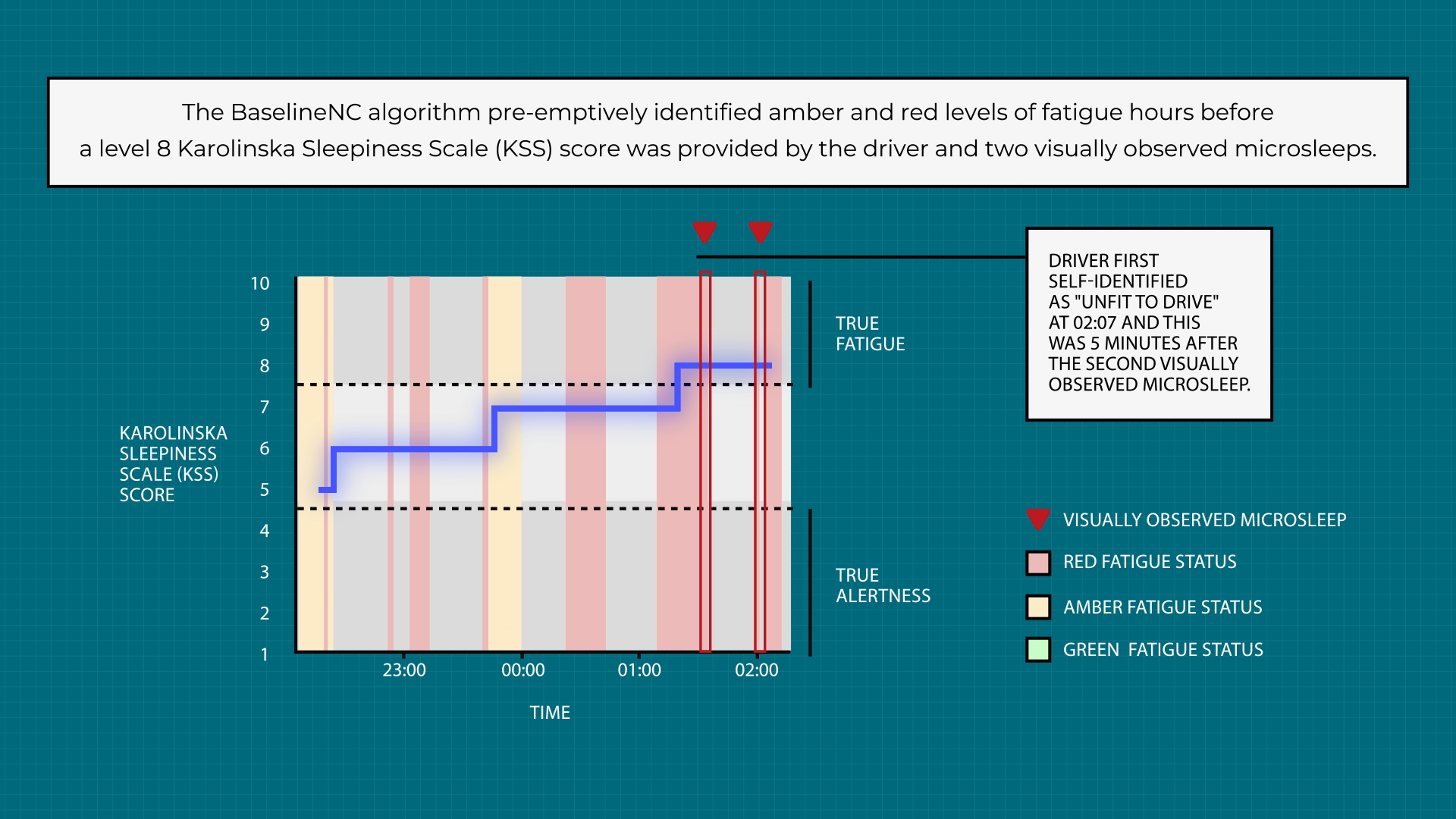
Why does this matter? Wearables detect fatigue before it affects performance, whereas eye tracking only sees fatigue once it is already impacting behaviour. Wearables allow you to intervene before it is too late. For example, one of the assessment results detailed in the BaselineNC Advanced Fatigue Monitoring System White Paper showed the pre-emptive detection of the onset of worker fatigue by BaselineNC HOURS before two visually observed microsleeps. There were also several other microsleep episodes within this time frame and BaselineNC was able to highlight the wearer’s steady decline to a state of dangerous fatigue.
Reactive alerts should be the last line of defense against this silent, ever-present risk.
The Benefits of BaselineNC to You, Your Workers, Your Organisation and the Public
Protect Humans and the Environment From Harm
Gain Financial and Productivity Benefits
Evolve From Only Worker Subjective Intuition and Self-Assessment
Scale an Organisational Workplace Fatigue Monitoring Solution
Prove Optimisations With Longitudinal Workplace Fatigue Data
Leverage Award-Winning Human Factors Expertise
BaselineNC White Paper: Advanced Fatigue Monitoring System
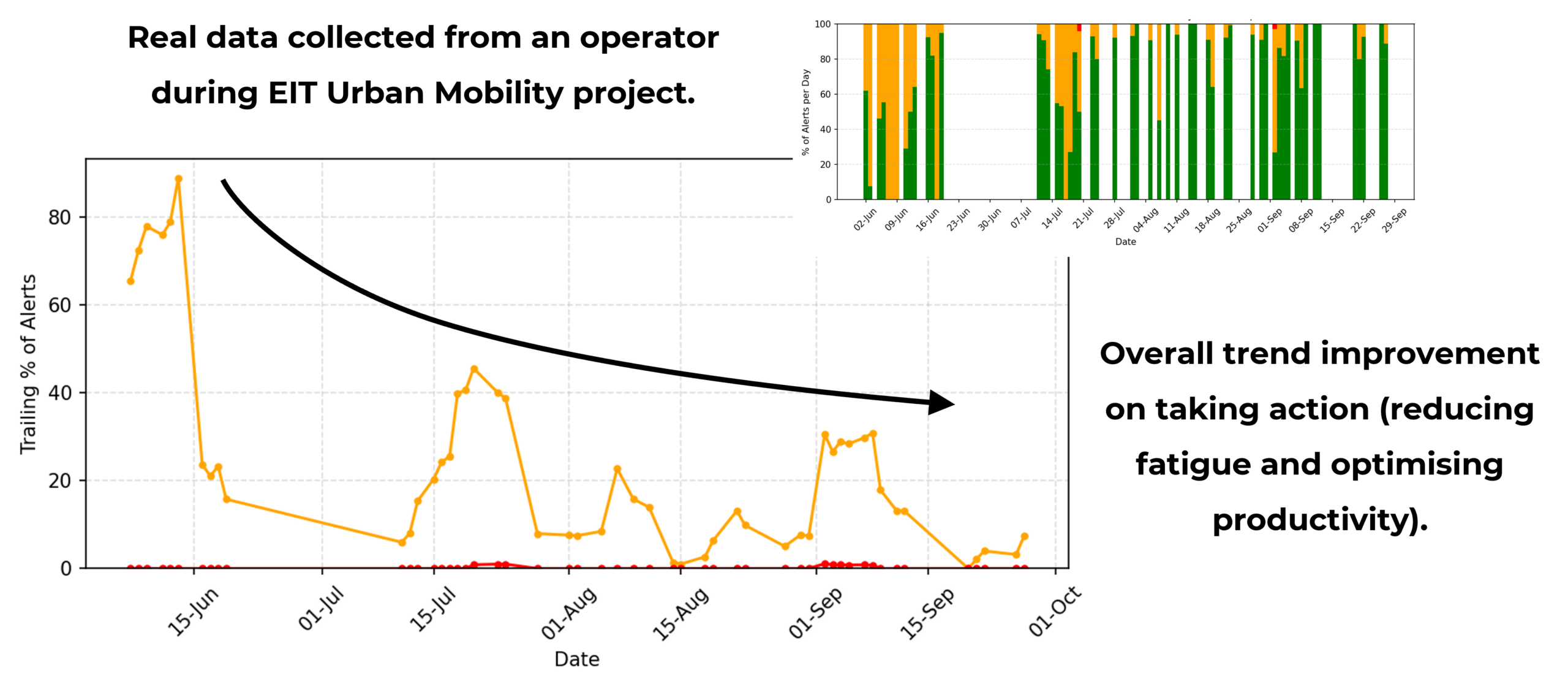
One of the common misconceptions that organisations hold regarding tackling the fatigue problem is lifting the lid (or opening the box). The charts below display real data collected from an operator during the BaselineNC EIT Urban Mobility project. There was an overall trend improvement on taking action (reducing fatigue and optimising productivity):
BaselineNC Case Studies



Frequently Asked Questions (FAQs)
Who is developing BaselineNC and what is their expertise in workplace fatigue?
Beginning as the Driver Innovation Safety Challenge (DISC), through to FOCUS+ and now BaselineNC, the project has seen the collaboration of academia, medical experts and industry to develop a world leading workplace fatigue monitoring system that can help save lives, reduce risk and deliver efficiencies in public transport but also across other industry sectors and safety-critical job roles. IHF was selected over 113 organisations to deliver the initial DISC contract and BaselineNC was shortlisted as part of the CBRE Innovation Challenge 2026 — as a straight finalist from 290 submissions — based on its client value, ROI potential, market differentiation and ease of implementation. As human factors experts, IHF were already working on this kind of technology and providing workplace fatigue consultancy services before the DISC project commenced.
Is BaselineNC a medical device?
BaselineNC is not a medical device and does not diagnose, treat, cure, prevent, monitor or alleviate any disease, injury, disability, medical condition or physiological disorder. It does not provide medical advice or determine medical fitness for work.
Are fatigue baselines individualised?
Yes, BaselineNC intelligently determines an algorithm — or a baseline — for each individual that continuously improves with usage.
How accurate is the biometric data and how has this been tested?
This white paper provides operational evidence — from a combination of comprehensive IHF and independent assessment results — that BaselineNC delivers effective situational awareness monitoring of fatigue onset with 98% biometric data accuracy. For example, one of the assessment results showed the pre-emptive detection of the onset of worker fatigue by BaselineNC HOURS before two visually observed microsleeps. There were also several other microsleep episodes within this time frame and BaselineNC was able to highlight the wearer’s steady decline to a state of dangerous fatigue. The BaselineNC wearable features carefully selected sensors — that happen to be medical grade — based on peer reviewed papers on their individual capability and efficacy of measuring fatigue. As a collective, these sensors provide further fatigue monitoring accuracy.
How is the biometric data managed regarding privacy and security?
The biometric data collected from the energy-efficient, lightweight, mobile and unobtrusive wearable is only shared with the individual concerned through the Android™ or iOS® mobile application. All data is encrypted in transit and in rest — end-to-end encryption (E2EE) — and complies with the highest standard of UK/EU GDPR rules. The “traffic light” RAG statuses — not the underlying biometric data — are also used for safety-critical control room alerts, dashboards and longitudinal operational insights for senior leadership.
If the biometric data is only shared with the individual concerned, how does this work?
Supervisors receive high-level alerts and see RAG statuses on a dashboard and not any of the underlying biometric data that determines this. By using a “traffic light” RAG status alert system — fatigued (red), approaching fatigue (amber) or not fatigued (green) — powered by human factors expertise and machine learning, this enables current worker fatigue and heat stress status updates to be sent wirelessly, close to real time — with GPS location information — to your control room supervisors, leading to timely safety-critical interventions with the aim of reducing human error.
What if our workers are hesitant to use this due to monitoring concerns?
When IHF speak to clients and potential clients about the BaselineNC predictive fatigue detection system, a couple of user-related questions are regularly asked:
- How do users feel about wearing a wrist-worn device that collects biometric data?
- How do users feel about biometric data being used to detect fatigue and predict longitudinal well-being?
These questions, concerns and general user adoption points have been considered throughout the development of the BaselineNC system. Generally, the system has been designed for the well-being of the user — as well as everyone else that could be impacted by a fatigue event — and should be considered as an added layer of personal protective equipment (PPE). When users are engaged early on and brought along the journey, they understand this is for health and safety, and tend to give buy in. Unions require engagement early on — as IHF have done — and have endorsed the technology.
The biometric data collected from the energy-efficient, lightweight, mobile and unobtrusive wearable is only shared with the individual concerned through the Android™ or iOS® mobile application. All data is encrypted in transit and in rest — end-to-end encryption (E2EE) — and complies with the highest standard of UK/EU GDPR rules. A lot of care, effort and time has been put in by ergonomics and human factors experts to design a comfortable user interface that makes sense and means something to the user. The “traffic light” RAG statuses — not the underlying biometric data — are also used for safety-critical control room alerts, dashboards and longitudinal operational insights for senior leadership.
Additionally, users are prompted at various times during a shift to enter a Karolinska Sleepiness Scale (KSS) score, enabling the correlation of real-time objective and intermittent subjective fatigue risk management data. Mitigating the dangers of self-assessed fatigue and the stigma attached to self-reporting fatigue. The BaselineNC workplace fatigue monitoring wearable is pushing the boundaries of fatigue detection with the objective and proactive analysis of biometric data. Therefore, IHF have been front-footed and proactive about considering and involving BaselineNC users and trade union representatives in this incredibly important journey.
Why is a wrist wearable suitable for workplace fatigue monitoring?
BaselineNC offers an energy-efficient, lightweight, mobile and unobtrusive wrist-worn industrial internet of things (IIoT) device for workplace fatigue monitoring. The wrist application allows for the passive and portable measurement of blood oxygen saturation, galvanic skin response, heart rate variability (RR), movement patterns using a 6-axis accelerometer and skin temperature, and can be considered as an extra layer of personal protective equipment (PPE). When an amber or red fatigue status is detected the wearable user receives a haptic alert (through sound and vibration).
Can the BaselineNC wearable detect workload-related fatigue (for example, active and passive fatigue)?
Yes, the array of biometric sensors in the BaselineNC wearable, coupled with the intelligent algorithm can detect variations and decline in both mental and physical output (making it suitable for both field and office workers).
Do workers need to wear the BaselineNC wearable whilst asleep or outside working hours?
This is not required, unless the individual wants to.
How does this differ from eye tracking technology used for workplace fatigue monitoring?
Detect Fatigue Risk Before It Emerges on Camera
Workplace fatigue monitoring is evolving fast, but not all solutions are created equal. While eye tracking measures blink rates and gaze patterns, wearable sensors go deeper. BaselineNC uses personalised biometric data such as blood oxygen saturation, galvanic skin response, heart rate variability (RR), movement patterns using a 6-axis accelerometer and skin temperature for a more holistic view of fatigue. Why does this matter? Wearables detect fatigue before it affects performance, whereas eye tracking only sees fatigue once it is already impacting behaviour. Wearables allow you to intervene before it is too late. For example, one of the assessment results detailed in the BaselineNC Advanced Fatigue Monitoring System White Paper showed the pre-emptive detection of the onset of worker fatigue by BaselineNC HOURS before two visually observed microsleeps. There were also several other microsleep episodes within this time frame and BaselineNC was able to highlight the wearer’s steady decline to a state of dangerous fatigue.
Reactive alerts should be the last line of defense against this silent, ever-present risk.
Does BaselineNC eliminate the collection of subjective intuition and self-assessment data from workers?
No, the quantitative and objective biometric data collected by BaselineNC works in parallel with the qualitative and subjective data collected from workers. The Verification and Validation (VnV) assessment process for BaselineNC used a cross-reference combination of Psychomotor Vigilance Testing (PVT), the Karolinska Sleepiness Scale (KSS), behavioural-based observations and situational awareness (SA) as a human performance attribute indicator. Workers are regularly asked to provide KSS scores as part of the BaselineNC system.
How does this impact our existing Fatigue Risk Management System (FRMS)?
BaselineNC has not been developed to replace your FRMS, but to complement and optimise it. BaselineNC can support healthy working patterns by using a more holistic human systems integration (HSI) approach — in relation to the physiological indicators of worker fatigue and heat stress — that also gathers valuable quantitative biometric data insights and does not just rely on limited one-sided qualitative data that is grounded in subjective intuition and self-assessment from workers, enabling a healthy break and substitution culture whilst validating shift pattern and working hours planning. Users are prompted at various times during a shift to enter a Karolinska Sleepiness Scale (KSS) score, enabling the correlation of real-time objective and intermittent subjective fatigue risk management data. Mitigating the dangers of self-assessed fatigue and the stigma attached to self-reporting fatigue.
Are the RAG insights generated by BaselineNC useful beyond alarms/alerts?
BaselineNC can elevate the dangers of worker fatigue into an enterprise-wide priority at your organisation — from front-line workers to the boardroom — using a data-driven and predictive analytics approach, that proactively aims prevent accidents and incidents and most importantly protect humans from harm and save lives. The RAG insights can be used to hone healthy shift patterns and working hours — that can be viewed at various levels in your organisation — using dashboards and other business analytics tools with the ultimate goal of improving your worker safety and well-being. This further enables the “human sensor” and allows for a “predictive maintenance” approach, that is often utilised in asset performance management (APM) — in relation to the pre-emptive detection of the onset of worker fatigue and heat stress. This ultimately supports the protection of the human asset while generating insights into fatigue patterns across shifts, enabling organisations to predict and optimise work schedules to promote healthier working practices and improved organisational performance.
How is BaselineNC piloted and tested in operational scenarios?
To prove the value of the BaselineNC solution, organisations are encouraged to run a 90-day low-cost and straightforward pilot testing process that involves collecting real longitudinal and objective data from workers during operational scenarios. The straightforward pilot testing process generally begins with a two-day kick off workshop with project stakeholders, then up to 80 hours/2 weeks of algorithm training, on the job through wearable usage to determine each worker’s baseline. Typical wearable users include frontline workers and control room personnel with users trained to provide local support.
After this initial phase, workers passively use the unobtrusive wearable in operational scenarios like it is another layer of personal protective equipment (PPE), enabling predictive analytics through real-time monitoring of biometric data. The overall technology — including the recommended cloud-based infrastructure and dashboard — is delivered by IHF who provide remote support, allowing you to focus on the pilot testing process and results (an on-premises implementation can be accommodated if required). Success metrics include user acceptance, operational data and performance insights, robustness of device and so on.